Good Girl Gone Bad
Play Good Girl Gone Bad
Good Girl Gone Bad Screenshots
















Good Girl Gone Bad review
Master every storyline, character route, and decision branch in this adult visual novel
Good Girl Gone Bad is a complex branching visual novel that puts player choice at the center of the experience. Created by Eva Kiss, this adult life simulation game follows Ashley through interconnected storylines where every decision shapes her character development and relationships. Whether you’re aiming for specific character endings, unlocking hidden scenes, or understanding the game’s intricate point system, this guide covers everything you need to navigate the game’s multiple paths. The game’s depth comes from its hand-crafted narrative design and the genuine consequences of your choices throughout gameplay.
Understanding the Game Mechanics and Point System
Ever felt that panic when a game asks you to make a choice, and you have no idea what it’ll lead to? 😅 I sure have. Playing Good Girl Gone Bad for the first time was exactly like that. I clicked what felt like a harmless, flirty option with a friend, and three chapters later, my character Ashley was in a situation so wildly different from my friend’s playthrough that we could barely believe it was the same game. That’s the magic—and the complexity—of this adult visual novel. To truly master every path, from the sweet romance to the most rebellious adventures, you need to understand its brilliant internal clockwork. This guide will break down the essential visual novel mechanics explained, so you can stop guessing and start directing Ashley’s story with purpose.
How the Good and Bad Point System Works
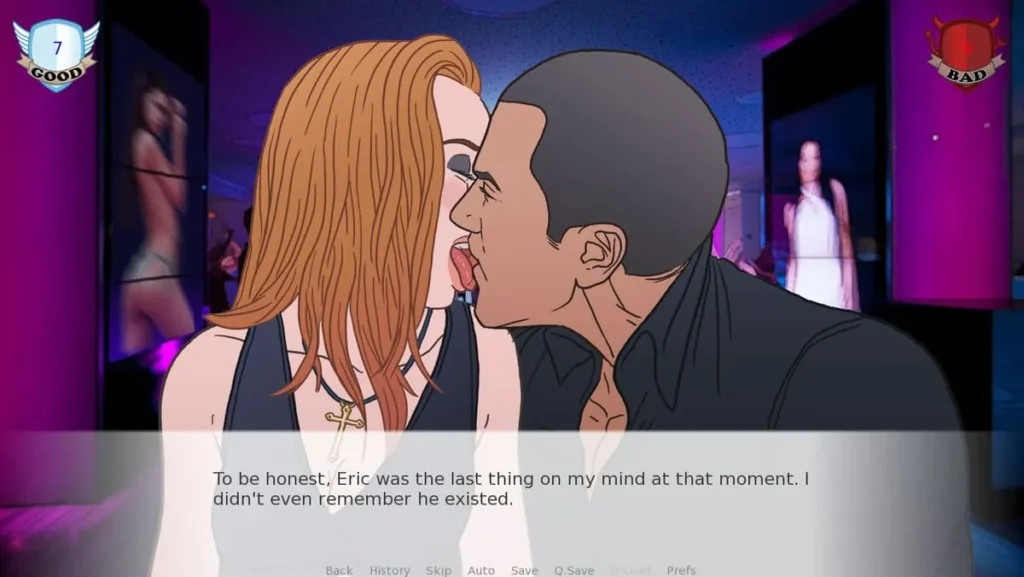
At the absolute core of Good Girl Gone Bad lies its elegant and defining mechanic: the dual point system. This isn’t just a simple morality meter. Think of it as two separate scales that weigh Ashley’s developing personality. On one side, you have Good points, which reflect her conscientious, rule-abiding, and kind tendencies. On the other, you have Bad points, which track her rebellious, selfish, and hedonistic impulses. 🎭
Every meaningful dialogue choice, action, and secret interaction in the game quietly adds to one of these tallies. Choosing to study for an exam, help a friend in need, or be polite to authority figures will typically net you Good points. Conversely, skipping responsibilities, being mean for your own gain, or indulging in risky behavior will rack up those coveted Bad points.
Here’s the crucial part: these points are not mutually exclusive. You can accumulate both! In fact, most complex playthroughs will see Ashley with a mix. The game’s narrative branches don’t just look at which number is higher; specific scenes, dialogue options, and entire story arcs have precise threshold requirements based on these scores. A scene requiring “20+ Bad points” won’t trigger if you have 19, even if you have zero Good points. This granularity is what creates the game’s incredible replay value.
For example, in my “Corporate Seductress” playthrough, I focused heavily on Bad points early—skipping work, manipulating colleagues. But I also kept a baseline of Good points by being secretly kind to one specific character. This unique blend unlocked a late-game office scene that was neither purely “good” nor “bad,” but a fascinating, power-driven middle ground that felt incredibly earned.
To help you plan your route, here’s a breakdown of common scene unlock requirements tied to the Good Girl Gone Bad point system:
| Scene Type / Arc | Typical Good Points Needed | Typical Bad Points Needed | Additional Conditions |
|---|---|---|---|
| Traditional “Good Girl” Ending Paths | 25+ | < 10 | High affection with a specific “good” love interest. |
| Early Rebellious Scenes (e.g., skipping class) | Any | 5+ | Often requires a specific prior choice to be available. |
| Major “Bad” Route Transformations | < 15 | 30+ | Must have failed or ignored key “good” obligations. |
| Balanced / Mixed Personality Scenes | 15-20 | 15-20 | Some of the rarest, most nuanced content in the game. |
| Corruption of a “Good” Path | 10-20 (initially) | Rapid increase during arc | Must start a “good” route, then make consistently corrupting choices. |
A key piece of Good Girl Gone Bad gameplay tips is to not fear specialization early on. If you want to explore a deeply rebellious path, commit to it! Dabbling in too many Good choices can lock you out of the high-Bad-point content you’re aiming for. The game remembers everything.
- Major Decision Point: Agreeing to help your boss after hours vs. blowing him off for a party.
- Consequence: Help = Good points + potential office route access. Blow off = Bad points + potential party scene chain.
- Major Decision Point: Telling the truth to a concerned friend vs. lying to cover your tracks.
- Consequence: Truth = Good points + strengthens that friendship. Lie = Bad points + opens up secretive, possibly shady, story branches.
- Major Decision Point: Investing time in studying/self-improvement vs. seeking immediate gratification.
- Consequence: Studying = Good points, unlocks intelligent dialogue options. Gratification = Bad points + often increases “Sexy” status.
Character Relationship Tracking and Affection Levels Guide
While the Good/Bad system shapes who Ashley is, the character affection levels guide determines who she connects with. Every major character—from love interests like Ethan or Eva to friends and family—has a hidden, independent affinity meter that tracks Ashley’s relationship with them. 📊
This is where the branching narrative choices get intensely personal. Raising affection isn’t just about always being nice. Sometimes, being boldly flirtatious or sharing a secretive, rebellious moment with a character will boost their affection more than any polite compliment ever could. It’s all about what that specific person responds to.
Each character’s route is gated behind reaching certain affection thresholds. Think of it as a series of locks. You might need “Affection Level 3” with Eva to unlock the option to spend a weekend with her, but reaching “Affection Level 5” is what opens the door to her most intimate and revealing scenes. Crucially, these levels are often combined with point system checks. You might need “Ethan Affection Level 4 + 15+ Good points” to unlock his romantic proposal scene, while “Ethan Affection Level 4 + 25+ Bad points” might unlock a completely different, more dramatic confrontation.
My biggest “aha!” moment was with the character of Rachel. I was being consistently friendly, but her affection was stagnant. It wasn’t until I started making choices that showed Ashley as more confident and daring—choices that cost me Good points—that Rachel’s affinity shot up. Her route values a partner who’s a fellow rebel, not just a nice friend. This independent tracking means you can theoretically max out multiple affection meters, but the branching narrative choices often force you to pick sides, creating authentic drama and replayability.
🚨 Pro Tip: Pay close attention to character-specific dialogue. An option that seems neutral might say “(Rachel will remember this)” or “(This pleases Dad).” These are direct signals about who your choice is impacting and how. They’re your best clues for managing multiple relationships.
Unlocking Hidden Scenes and Special Conditions
This is where Good Girl Gone Bad transforms from a game into a puzzle box of narrative possibilities. 🧩 Beyond simple point and affection thresholds, the game employs a sophisticated web of special conditions that gate its most exclusive content. Understanding this layer is the key to moving from a passive player to an active director of the story.
The most famous condition is the “Sexy” status. This isn’t just about wearing revealing clothes (though that can contribute). It’s a cumulative flag built by making choices that increase Ashley’s confidence, boldness, and sexual experience. Taking risque photos, winning a dance-off, or successfully flirting in high-pressure situations can all raise this invisible stat. Many hidden scenes, especially those involving attraction or seduction, require Ashley to have a certain level of “Sexy” in addition to other criteria. A character might have high affection for you, but if Ashley isn’t “Sexy” enough, they might not see her in a romantic light.
Furthermore, the game meticulously tracks the completion of specific actions and events. These become unlocking hidden scenes conditions later on. For instance:
* Having taken pictures at a specific earlier event might unlock a blackmail or leverage option later.
* Getting a tattoo in one chapter might change how certain characters interact with you for the rest of the game, opening new dialogue branches.
* Failing a task (like losing a job) isn’t just a setback; it’s a condition that reroutes the entire story, making new scenes and opportunities available that a “successful” Ashley would never see.
Let’s talk about a practical example from my playthroughs. To unlock a very exclusive, late-game scene with a dominant character, I needed a specific cocktail of conditions:
1. Bad points > 40 (A very high threshold, requiring dedicated rebellion).
2. Specific character affection > Level 5 (This required a series of submissive and agreeing choices with them earlier).
3. “Sexy” status at maximum (I had to seek out bold experiences across several chapters).
4. Having completed a prior, seemingly minor task for them in Chapter 6 (This was the real kicker—a choice I’d written off as insignificant at the time!).
When that scene finally unlocked, it felt like winning a championship. That’s the genius of the Good Girl Gone Bad point system and its condition-based design. It rewards careful play, curiosity, and multiple replays. You’re not just reading a story; you’re assembling a unique set of keys (points, affection, flags) to open doors you didn’t even know existed.
So, dive back in. Use this knowledge of the visual novel mechanics explained here not as a cheat sheet, but as a blueprint. Experiment boldly. Save often before major decisions. And remember, in Good Girl Gone Bad, there are no wrong choices—only different stories waiting to be discovered. Your next playthrough could reveal a side of Ashley, and her world, that you never imagined. The ultimate Good Girl Gone Bad gameplay tips is this: embrace the chaos, track your progress, and enjoy the incredible depth of one of the most responsive branching narrative choices systems in the genre.
Good Girl Gone Bad offers a richly branching experience where your choices genuinely matter. By understanding the point system, character mechanics, and decision consequences, you can craft Ashley’s story exactly as you envision it. Whether you’re pursuing specific character endings, unlocking hidden content, or exploring the full scope of the narrative, this guide provides the foundation for meaningful gameplay. The game’s strength lies in its complex branching design—no two playthroughs need be identical. Take your time exploring different choices, experiment with various character routes, and discover how the interconnected storylines create a cohesive yet deeply personal experience. Your next playthrough awaits with entirely new possibilities.